Category Archives: Sean Carey

Is your mind like a foraging squirrel in a park? Seán Carey

“The mind races around like a foraging squirrel in a park, grabbing in turn at a flashing phone-screen, a distant mark on the wall, a clink of cups, a cloud that resembles a whale, a memory of something a friend said yesterday, a twinge in the knee, a pressing deadline, a vague expectation of nice weather later, a tick of the clock,” says Sarah Bakewell in her excellent new book on phenomenology and existentialism, At The Existentialist Cafe: Freedom, Being, and Apricot Cocktails.

Squirrel

In the analogy of the mind as a foraging squirrel there’s no doubt that Bakewell provides a pretty good description of how many of us experience the world while we are awake. However, whether everyone in all cultures, or indeed at all times, experiences life in such a frantic fashion is an interesting question. I would argue not. Why? Well, partly on the grounds that Bakewell’s list of attention-demanding objects or experiences is so thoroughly Western, urban and post-modern (think of people working in cities such as London, New York, Paris or Tokyo who make their livelihoods through listening, talking and typing and take frequent coffee breaks but probably not East African hunter-gatherers digging for tubers, collecting baobab fruits or chasing baboons), and partly on the grounds that those of us who have had lessons from a competent Alexander Technique teacher know very well that when the head achieves a better balance on top of the spinal column, allowing the neck and back muscles to provide support and stability for the whole body, this results in a less strained, more rhythmic pattern of breathing as well as clearer vision. At this point our experience of ourselves in time and space is no longer dominated by a habitually restless squirrel-like mind with a subordinate, barely-felt body but is transformed into an experience and also an appreciation of how one’s body and mind are so profoundly interconnected.

For more information on using the arms and hands read Seán Carey’s ‘Alexander Technique in Everyday Activity: Improve how you sit, stand, walk, work and run’

Available through Amazon for £18.99 with free P&P.

Private one-to-one Alexander Technique sessions can be booked with Seán Carey on Thursdays afternoons with HITE Ltd, 10 Harley Street, London W1G 9PF. Tel: 020 7467 8461

How do you use your hands?

pencil_grip3

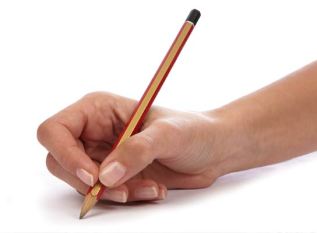
What’s the difference between you and your nearest living relatives, chimpanzees and bonobos? Well, not too much in terms of DNA percentages but quite a lot in terms of how the hands work. One key difference is that while chimps and bonobos have long fingers but short, weak, immobile thumbs, you have relatively short fingers but long, strong, mobile thumbs. The result is that, unlike your great ape relatives, you can you fully oppose your thumbs and the pads of each of your fingers, a pattern that enables you to grip or pinch objects with great precision. You employ it all the time in everyday life – for example, when buttoning your shirt, text messaging, or holding a pencil or picking up a coin.

Interestingly, healthy, young children are very dextrous – typically, toddlers can easily hold a round object such as a ball much bigger than their hand by elastically opening the hand very wide, thumb angled away from their other fingers, and then making contact with the top or side of the ball with a minimum amount of flexion or grip. It’s as if the child’s hand is sticking to the ball. How many adults are capable of this? Not many because most of us create too much muscle tension not only in the hands and arms but also in the rest of the body’s musculature, especially in the upper torso. Which is a great shame. But you can learn how to undo excess muscular tension by paying attention to how you use your hands in conjunction with what FM Alexander, the founder of the Alexander Technique, called the ‘primary control’ – maintaining the balance of your head, while your supportive back muscles lengthen and widen to provide stability not only for your head but also for your arms and hands.

By Seán Carey PhD

For more information on using the arms and hands read Seán Carey’s ‘Alexander Technique in Everyday Activity: Improve how you sit, stand, walk, work and run’

Available through Amazon for £18.99

Private one-to-one Alexander Technique sessions can be booked with Seán Carey on Thursdays afternoons with HITE Ltd, 10 Harley Street, London W1G 9PF. Tel: 020 7467 8461

How do you do the housework, in Goa?

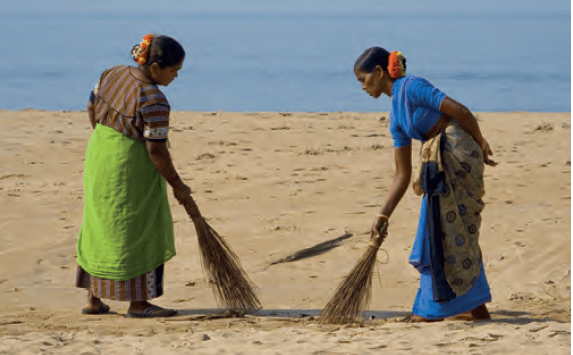
Goa’s Patnem Beach

Can you lean forward from your hip joints, holding a brush, without compressing your double S-shaped spine, stiffening your legs and feet, or pulling your head down on to your neck? If you spend long hours sitting in a C-shaped slump in front of a screen, the answer is probably not. But look at this photo of two women sweeping Goa’s Patnem Beach just after sunrise. You will see that the woman in the blue sari is working much more efficiently than her colleague. By placing her open left hand on her lower back, the weight of that arm (around 4% of her body weight) can release through her pelvis, her legs and then into the ground. Her supported left arm also counterbalances the weight of her right arm which is holding the short broom made from coconut leaves. That, in turn, helps to keep her spine extended, supple and strong. Very clever. It also means that she will never experience chronic lower back pain!

By Seán Carey

For more information on how to bend and use yourself better read Seán Carey’s much-acclaimed book, ‘Alexander Technique in Everyday Activity: Improve how you sit, stand, walk, work and run’
Available through Amazon for £18.99


Can you stand on your toes?

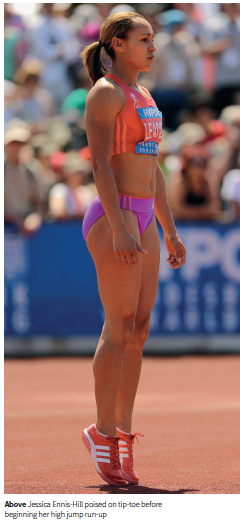
Jessica Ennis-Hill

What do you do if you want to eat a juicy, but just-out-of reach, apple on a tree? You go up on to your toes, of course. In fact this movement on to the toes has likely played a very important part in the evolution of the uprightness and mobility of our species, including the unique ways humans walk, run and jump. Healthy, young children from all cultures are very good at going on to the toes – they just pop upwards – though interestingly many of us adults in Western-type societies perform the movement very badly. Why? Well, instead of maintaining alignment with your head balanced on top of your extended, double S-shaped spine, chances are that as you initiate the movement on to your toes your neck muscles will shorten and stiffen which, in turn, will result in your head compressing your spine and narrowing the back musculature. Simultaneously, you will sink into your legs and throw your body forward. Put simply, you have lost some of your internal length or, to use FM Alexander’s apt phrase, you have ‘shortened your stature’. Does it matter? It certainly does if you’re hungry and can’t stretch those extra centimetres to get that lovely apple! And shortening your stature not only involves stiffening from your head to your toes but also means that you are fixing your rib cage and barely breathing. Not good. But look at this picture of 2012 Olympic Heptathlon Champion Jessica Ennis-Hill standing on her toes in preparation for her run-up in the high jump. Jessica has brilliant alignment – head poised, spine extending, her back musculature widening, and her leg muscles stretching without strain. One last thing: although she is relatively small for a high jumper – she stands at 1.65 metres (5′ 5″) – Jessica has jumped 1.95 metres (6′ 5″) and was for many years joint British record holder for the outdoor event.

By Seán Carey

For more information on how going on to the toes should be performed read Seán Carey’s much-acclaimed book, ‘Alexander Technique in Everyday Activity: Improve how you sit, stand, walk, work and run’
Available through Amazon for £18.99

How do you stand?

Seán Carey explains how humans are the only animals that have the potential to stand fully upright – though how many of us actually do that?

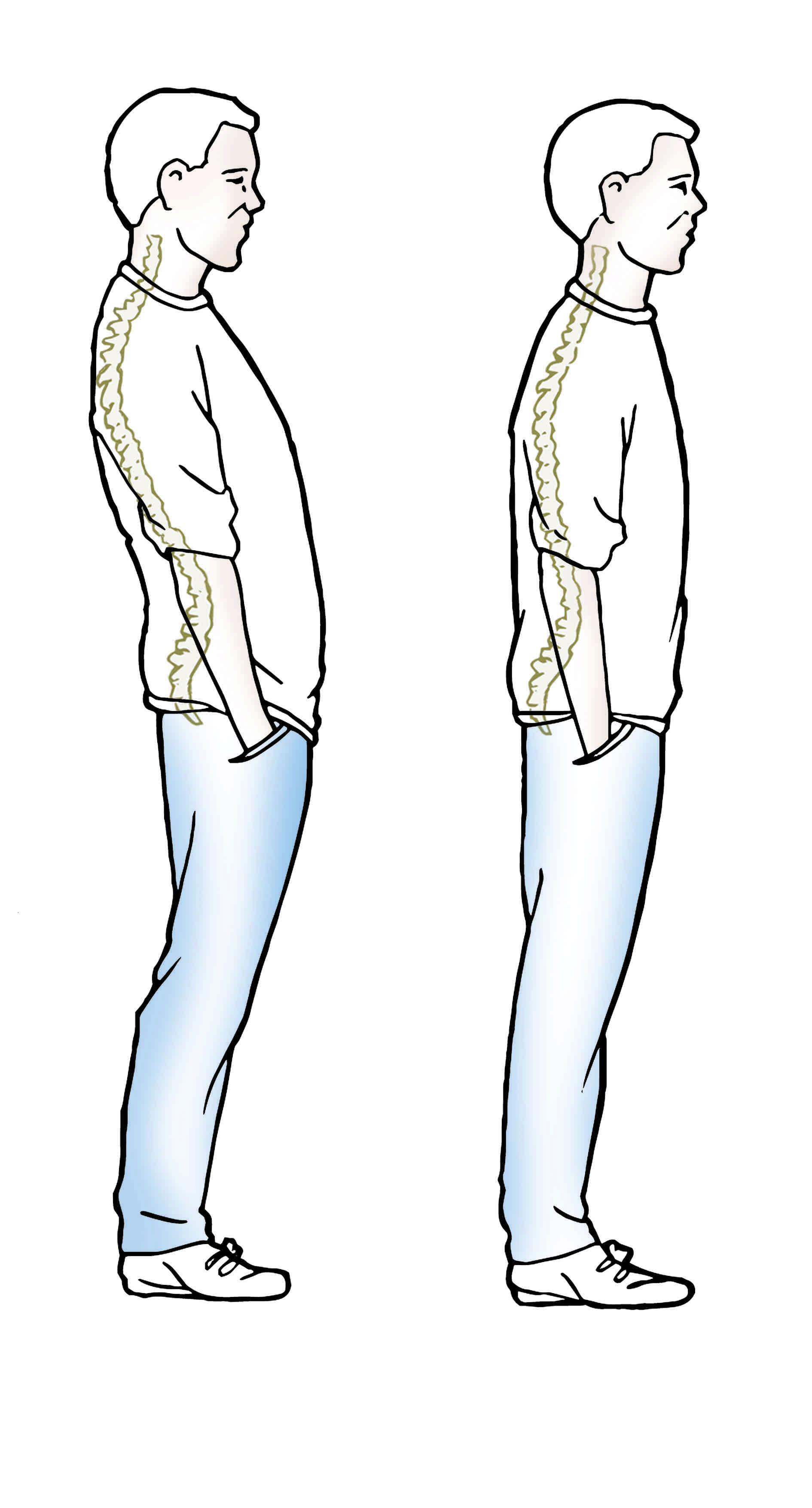
Standing male posture

How much do you weigh? Eight, 10, 12 or 14 stone? Whatever your body weight you need good support from your musculoskeletal system to stand without strain. In fact, humans are the only species that can stand in a fully upright stance, with flexible ankles and fully extended knee and hip joints. With our joints stabilised by ligaments, body weight is then efficiently transmitted into the ground through the bones of a double S-shaped spine, pelvis, legs and the platforms of the feet, notably without much need to use the body’s large, powerful muscles, such as the gluteals, thighs and calves. Intriguingly, as anatomists have discovered, this alignment allows a healthy person to stand for hours, swaying slightly, using only seven per cent more energy than while lying on the ground.

But how many of us are capable of such efficiency in quiet standing? Very few, alas. The big problem for most of us is that we never, ever manage to come up to the potential of our full height – that is, the measurable distance between the crown of the head and the soles of the feet. Instead, we tend to droop or collapse, pulling the head down on to the neck, raising or collapsing the shoulders, pulling the lower back in and pushing the pelvis forward, as well as stiffening the muscles that operate the ankle, knee and hip joints. Given this pattern of mal-coordination, it’s hardly surprising that many of us suffer from a variety of musculoskeletal problems – chronic lower back pain, chronic neck pain, shoulder stiffness, achy legs or flat feet – as well as fatigue.

So is it possible to improve the efficiency of how you stand? Yes, although it’s fair to say that this takes more brainwork than physical work. For example, there’s no point trying to get some extra height by tightening the abdominal, gluteal or other muscles to ‘engage your core’ or by ‘tucking your tailbone under’. If you do either of these things you will only create additional tension – yet another ‘different form of badly’ to use philosopher and Alexander Technique enthusiast John Dewey’s pithy phrase – rather than a genuine release of your body’s musculature brought about by Alexander-style thinking (‘ordering’ or ‘directing’) that allows you to achieve your full height.

Seán Carey

For more information read Seán Carey’s Alexander Technique in Everyday Activity: Improve how you sit, stand, walk, work and run

Available through Amazon with free P&P

Pointing is key

Pointing is key to learning the Alexander Technique – Seán Carey PhD

‘See, even at the age of 98, I can still move my arms above my head,’ said Elisabeth Walker at the end of my one and only lesson with her at her Oxford home. She was responding to my question concerning whether FM Alexander, the founder of the Alexander Technique, had offered her and other students on his teacher training course much advice about extending or pointing the arms out to the sides, or above the head. ‘But he didn’t really make a big thing about it,’ she added. ‘Nevertheless, it’s very good for musicians and other people who get very tight in the armpits and need to get release.’

That conversation got me thinking more about gesture and pointing in particular. Humans are a very social species and a crucial building block in the development of that sociality is movement of the arms and hands, with or without accompanying speech. One gesture that seems to be especially important in our social development is pointing with an extended index finger. In fact, you would have started using that gesture around your first birthday, before you could talk, to get and direct the attention of adults and other children nearby to an object you wanted, such as food, a drink or a toy, or something that you found interesting, such as a hovering bumblebee, a slow-moving cat or a fast-moving aeroplane. In doing so, you discovered that movement can initiate and then maintain shared body-mind experiences. Simply put, people pay attention when you point, and you pay attention when they point.

It’s also evident that what comparative or developmental psychologists call purposeful or declarative-pointing with the index finger (which triggers extension or lengthening of the arm as illustrated in the photo below) is something for which we are peculiarly well adapted. It’s a behaviour found in all cultures. Some psychologists go further and claim that directed index finger-pointing is a uniquely human gesture as there is no reliable account of any of our great ape cousins living in the wild using it to communicate with other apes.

 

shutterstock_41063452

Above We are peculiarly well-adapted to pointing with our index finger

The unique human ability to point not only your index finger but also your other fingers is certainly used to good effect in the Alexander Technique as it forms an important part of some specialised procedures, one of which Elisabeth Walker demonstrated for me in March 2013.

Another example is placing hands over the back of a chair. Alexander himself would ask a student to sit upright on a chair facing the back of a second chair equipped with a reasonably high back. Maintaining the balance of the head on the neck he slowly brought the student’s body forwards from the hip joints, carefully monitoring whether at any stage they compressed their double-S shaped spine. (If that happened Alexander would go back to the beginning of the sequence.) With the student leaning forward at an angle Alexander instructed them to take their time and then extend or point their fingers before taking hold of the top rail of the chair in front, using a gentle but firm beak-like grip with each hand, with the wrists pointing inwards towards each other and the elbows pointing outwards and slightly downwards. This opposition of fingers, wrists and elbows pointing in different directions creates a gentle forearm pull or stretch from the fingers-opposing-thumbs contact. This can be further amplified by directing the shoulders to release or point away from each other.

If you are not familiar with the procedure it might appear to be rather strange. In fact leaning forwards and then placing the hands on the back of a chair in this way generates a dynamic, elastic muscular release not only in the arms but also in the neck and shoulder girdle, and rib cage and pelvis. It also helps to fine tune your kinaesthetic sense. I have written about hands over the back of a chair in sitting and standing in some detail in my new book, Alexander Technique in Everyday Activity.

And I remember talking to Alexander’s niece, first-generation teacher Marjory Barlow, who I interviewed for Alexander Technique: the Ground Rules, about the problem many new students of the technique experience in letting their knees release forwards from the hip joints and away from each other as they move from standing on two feet to sitting in a more balanced way on their downward-pointing sitting bones. Marjory told me that whenever she encountered any difficulty she would not only ask the student to inhibit their immediate reaction to the stimulus to sit (typically by trying to actively place their bottom on the chair, pulling their knees together and pulling their head down on to their neck) but also ask them to think about and then consciously point their knees forward and away in the direction of suitable objects in her teaching room, such as a radiator or lamp, as with her hands she provided the experience of maintaining the integrity of the head, neck and back relationship. It was good advice.

A final thought. When you were younger you may have been told off by your parents for pointing at other people – “Don’t point, it’s rude!” is the customary form of words – but I hope I have said enough to convince your adult self that inhibiting and then pointing your fingers, elbows and knees and mentally other body parts, such as the shoulders, using the minimum amount of effort, is a good thing. In fact, it’s key to learning the Alexander Technique.