Category Archives: Uncategorized

Mastering Semiflexion in the Alexander Technique – Effortless Movement with Seán Carey

In this exclusive excerpt from his new book Exploring the Alexander Technique with Walter Carrington: Lessons and Games, Seán Carey reveals how mastering semiflexion, a simple bend of the ankles, knees and hips, can unlock effortless movement, create better balance and facilitate an energising release in tension.

Learning to acquire competence in semiflexion often requires sustained hands-on assistance from a teacher to maintain proper form and prevent the triggering of ingrained habits.

On the other hand, if performed correctly, semiflexion represents a dynamic position of mechanical advantage. As you descend from a fully upright position to an intermediate or even a deep squat, there will be a beneficial redistribution of muscle tension. At the same time, your rib cage contracts and expands elastically and your feet open onto the ground.

When you return to upright from semiflexion, you may experience a powerful release and noticeably improved muscle tone. The dynamism of this attitude has been created by the antagonistic muscular actions of the body parts releasing in opposite directions – ‘head forward, knees forward, hips back, one against the other’ – as Alexander, by way of encouragement, often said.

Each day of the training course Walter offered hands-on work to all students and teachers, which usually involved chair work, but during some sessions he showed me different ways of moving into and out of semiflexion. 

On one occasion he stood to my left and used his hands to help me find a better balance. As my neck column released upward, my back opened out, and my feet released onto the ground, he instructed me to direct my head forwards and up, saying, ‘Don’t do anything, just think it’, and guided me into semiflexion.

Walter then told me to think of releasing my ankles even more so that my shins ‘fell up and forwards’, while directing my thighs ‘back and up’ or towards my pelvis. Still in semiflexion I was also asked to direct my torso to follow the lead of my head.

On another occasion Walter emphasised the importance of lengthening and widening the torso to perform semiflexion. He had me stand behind him and place my hands on either side of his rib cage. 

Next, Walter moved into the position of mechanical advantage by bending his ankles, knees and hips. I could feel with my hands that he was not sinking into his legs because he was maintaining the lengthening of his spine and the widening of his back. 

Walter then guided me through the movement. As I stood, he placed his hands on my rib cage and asked me to direct my back ‘back and up’ as he took me slightly up and back from my ankles. Because my back was elastically releasing this made it very easy to bend my ankles, knees and hips. 

To exit semiflexion Walter gave me two options. First, he recommended thinking of my head moving back to its full height, which would cause my legs to straighten without any clenching or pushing required. Alternatively, he steered my hips back and down, explaining that allowing the tail to drop slightly would cause my head to rise, much like a seesaw. As a result of this guided movement, I discovered I could move my head away from my heels to stand upright without using unnecessary muscular effort.

However, there are other effective ways to transition from semiflexed to upright that you can play around with. For instance, if your back muscles are properly engaged, you can walk forward without wobbling and gradually, without stiffening your neck, lifting your chest or pulling your back in, come upright. You can also walk backwards, directing your back back and then gradually return to a vertical attitude. 

Seán Carey’s book, Exploring the Alexander Technique with Walter Carrington, is now available. This exclusive hardback book offers practitioners an insider’s perspective into Walter Carrington’s profound teachings and approach. 

Order your copy of this limited edition today via the HITE website or Amazon.

Exploring the Alexander Technique with Walter Carrington

NEW BOOK RELEASE 

Exploring the Alexander Technique with Walter Carrington by Seán Carey
ISBN: 978-1-9160728-1-7

Author and certified Alexander Technique teacher Seán Carey, PhD, invites you, in this new book, to go on a journey that explores the essence of the Alexander Technique through the unique perspective of one of its most notable figures, Walter Carrington.

In today’s fast-paced, digitally-driven world, the Alexander Technique holds remarkable relevance. It offers a profound understanding of the body-mind connection, unlocking potential for better coordination, movement and well-being.


Walter Carrington’s journey is a remarkable one. He not only studied with FM Alexander himself in London, qualifying in 1939, but later assumed the role of Alexander’s assistant. He eventually assumed responsibility for the teacher training course after Alexander died in 1955. 


Walter’s legacy has left an indelible mark on the global Alexander Technique community, and Seán’s book brings a fresh and insightful perspective to the subject matter.


Exploring the Alexander Technique with Walter Carrington is divided into five parts that each present a unique angle on Walter’s lessons and the Technique itself:
1. Meeting Walter Carrington: Read the author’s first-person story of their initial introduction to Walter.
2. A Historical and Contemporary Context: Learn about the origins and ongoing applicability of the Technique using Seán’s learning journey, including advice from other first-generation teachers like Peggy Williams and Elisabeth Walker.
3. Private Lessons with Walter: Through transcriptions of 8 private lessons shared publicly for the first time, you can access the essence of the Technique. 
4. Mastering the ‘Games’: Immerse yourself in 28 engaging ‘Games’ inspired by Walter’s teacher training course, many of which are unique to this publication and each carefully crafted to enhance your practice. They include novel insights into releasing arms with direction, going on to the toes while performing hands on the back of a chair, leaning against a backrest, placing palms on a table or chair to transfer body weight, pelvic rotation and many others. 
An ideal way, in the words of FM Alexander, of ‘informing your whole body with thought’.
5. The Powerful Tools of Inhibition, Direction and Movement: Delve into a thought-provoking exploration of these principles and their application in our digital age.

This exclusive hardback book offers practitioners an insider’s perspective into Walter Carrington’s teachings and approach. 

All Alexander Technique teachers should read this book. Walter Carrington, taught by FM Alexander, had a well-deserved reputation for clarity and simplicity in his presentation of the Technique that shines through here. The simplicity is of the kind that can only come from the deeply lived experience of embodying and teaching the work, which is why this collection of Walter’s thoughts and training practices is valuable.
John Nicholls, MA (Oxon), Alexander Technique teacher trainer and international Alexander Technique teaching and training consultant

Seán Carey continues his project of documenting the practices of the first generation of Alexander Technique teachers for a contemporary generation of students and teachers. The book outlines and revitalises the tradition of ‘Games’ devised and practised by the Carrington teacher training course, showing how relevant they are to us today – encapsulating as they do the Alexander Technique principle in action in a wide range of activities
Gary Ansdell, Honorary Professor, Department of Sociology, Anthropology and Philosophy, University of Exeter

Seán Carey offers another welcome and expertly researched book for teachers and students of the Alexander Technique. Written in an accessible style, he shares insights and guidance on practical ways of thinking and activity, whilst paying a warm personal tribute to the teachings of Walter Carrington.
Virginia Stephens, PhD, Alexander Technique teacher

https://www.hiteltd.co.uk/webshop/books/exploring-the-alexander-technique-with-walter-carrington-lessons-and-games/

The chronic lower back pain conundrum – Seán Carey

Sitting posture

Much excitement over a recent article by The Guardian’s medical journalist, Dr Luisa Dillner, in which she canvasses the views of a physiotherapist, an osteopath and a ballet teacher on the vexed topic of ‘good’ and ‘bad’ posture, with a special focus on the latter’s effects on health and well-being.

There were several strands to the argument but the main theme was that so-called bad posture – ‘usually defined as slumping, leaning forwards or standing with a protruding belly’ – is not the primary reason why so many people in the UK experience chronic lower back pain.

This is not a new argument. As I explain in my book, Alexander Technique in Everyday Activity: Improve how you sit, stand, walk, work and run, the reasons why people develop chronic lower back problems are multiple and complex:

‘Although the precise cause of chronic back pain is often difficult to pinpoint, it is usually related to conditions such as herniated disc – the so-called slipped disc – and by a variety of inflammatory processes in the musculoskeletal system, as well as age-related degeneration, especially in those over 65.’

I also highlight that lower back pain is linked to anxiety and stress.

And in my book, I offer some advice to those suffering from chronic lower back pain – namely, that it is very important to obtain an accurate medical diagnosis in order to rule out any existing medically treatable pathological problem of the spine.

Interestingly, the physiotherapist and osteopath interviewed by Dr Dillner did concede that once someone has developed chronic lower back pain ‘posture may affect it’ and that ‘sitting for a long time’ is best avoided.

But what wasn’t mentioned in The Guardian article (though it is covered in my book) concerns an important discovery made in 2006 by a team of Canadian and Scottish scientists.

It is that how we sit on a chair has enormous implications for spinal health. The team, which used an innovative whole-body MRI scanner to investigate 22 adult volunteers with ‘healthy backs’, found at the start of the study that despite being asymptomatic 12 of the group exhibited a significant degree of disc degeneration or disc protrusion.

The scans then revealed that sitting on a chair with feet touching the floor in either a forward slouch or an upright 90 degrees, ‘good posture’ position, had a significant impact on the vertebral column, since the lower spinal discs in particular were already showing signs of deformity.

In fact, this effect was greatest when subjects adopted the sit up ‘straight’ position. In as little as 10 minutes fluid was leaking out of the inner core of the discs. This finding is highly significant, considering that the 23 sponge-like intervertebral discs constitute around one third of the total length of the spine, and play a critical role as shock absorbers in everyday movement, especially in bending and twisting motions.

From an Alexander Technique point of view sitting up ‘straight’, as most people in our culture understand it, is in fact over-straight. Simply put, it’s just another way of tightening the neck, raising the chest and hollowing the back. In turn, that misuse lifts the sitting bones from the chair and transfers body weight on to the thighs, creating inappropriate downward pressure along the spinal column, including the discs. The alternative of slumping isn’t much better.

Instead, in order to sit upright painlessly and efficiently we need to learn the skill of giving our weight to our ischial tuberosities – the sitting bones at the base of the spine.

Only then can our anti-gravity and non-tiring support muscles transfer the weight of our head, upper body and arms into whatever support surface is available. This could be the ground itself, or a raised surface such as a chair, tree stump or rock, or moving surface such as a horse, elephant or camel.

To make this clearer you can try this experiment. Locate your sitting bones by sitting on a flat surface, such as a wooden chair, and put the palm of each hand under each buttock. Through the skin, fatty tissue and thick muscle you will feel a bony protrusion under each hand. At this point let yourself slump so that your spine assumes a C-shaped curve. You will notice how you roll on to the back edge of your sitting bones and your weight transfers on to the rear of the pelvis and towards the tailbone (coccyx).

Now try sitting up ‘straight’. Chances are that you are now arching your back. If so, you will experience how your support contact moves on to the very front edge of your sitting bones, in such a way that much of your weight is taken by your thighs.

By contrast, see if you can find a way of sitting in balance so that your weight is taken more or less by the middle of the curved arch of your sitting bones, with your double S-shaped spine extending upwards and your head freely poised on top of it.

This is balanced sitting. It’s easier said than done, of course. But it’s the only way to sit to avoid exacerbating chronic lower back pain, while also preserving the long-term integrity of the discs of your spine.

You can read more about an Alexander approach to sitting and other movements in Seán Carey’s Alexander Technique in Everyday Activity: Improve how you sit, stand, walk, work and run

Available through Amazon with free P & P


Going up the wall – Seán Carey

FM AleWall Work102Lxander told Marjory Barlow and the other students on his first training course group that once they had qualified as teachers they would find wall work very useful to perform in the intervals between lessons, especially if there wasn’t sufficient time to lie down on the floor or table. One reason why wall work is so valuable, FM went on to explain, derives from the sensory feedback that becomes available by lightly placing the whole of one’s back against a firm surface, such as a smooth wall or door, head freely poised on top of the spine and, then, using inhibition and direction, to make one or more carefully-thought-out movements.
Going on to the toes is one such movement. With your head leading, slide your body upwards (in stages if necessary) – ‘take plenty of time,’ Marjory advised me when I performed the movement in her teaching room – so that you go on to the balls of your feet and then your toes, without pressing back against the contact surface or bracing back your knees or holding your breath. Having arrived on tiptoe, it’s a good idea to pause at this juncture and release any unnecessary holding or excess tension in the buttocks, lower back, knees and ankle joints made while moving upwards. (When first performing the activity most of us will find that there’s often quite a lot of tension to discard. But definitely one way you can help the process along is by directing your heels to release away from your sitting bones or hip joints.) To return to the floor maintain your light contact with the wall or door and allow your ankles to release very slowly so that you maintain your internal length.

You now have the task of coming away from the wall without using some sort of leverage – for instance, by not succumbing to the desire to push with one or both of your buttocks or employing a quick flick of your shoulder blade. That, of course, is easier said than done – a true test of inhibition and direction.

You can read more about Marjory Barlow’s Alexander teaching techniques in Seán Carey’s new book, ‘Think More, Do Less: Improving your teaching and learning of the Alexander Technique with Marjory Barlow’, which has been written for Alexander teachers, trainees and advanced students. It is now available through Amazon or HITE.

Marjory Barlow’s ‘Dimple Test’ – Seán Carey

Alexander told the students on his first training course that one very effective way to encourage the musculature of their back to work was to come back as an integrated unit in small movements from the pivot point of their ankle joints.TMDLpage83


The big problem for most of us attempting the activity on our own is that before initiating the movement back from the ankles it’s necessary to be reasonably well-coordinated – your head needs to be going forward and up, your back lengthening and widening, and your knees releasing forward from your free hip joints and slightly away from each other while maintaining a good connection to your feet. That’s often not the case, of course. Many of us obtain an upright stance not by lengthening the stature but by shortening it – specifically, pushing the pelvis forward, pulling the tailbone (sacrum-coccyx) and buttocks upwards towards the lower back, and also locking the knees, hips and ankles. One major result of this tangled malcoordination is that the pelvis is pulled down on to the legs instead of it being an integral part of the torso. As FM Alexander’s niece and first-generation Alexander teacher Marjory Barlow observed if someone is standing in this very common pattern of misuse and then attempts to come back from the ankles this will only serve to amplify or increase the degree of their stiffening.

The dimple test

Marjory suggested that if you have a habit of displacing your pelvis forward and hollowing your back, it’s useful to get a measure of that misuse, ideally with the aid of a mirror, by using what she called ‘the dimple test’. It’s very simple and straightforward. While standing, without raising your shoulders or pulling your head down to your neck, place the palms of your hands, with your lengthening fingers extending downwards along the outside of your thighs so that you can feel the dimple or hollow on the outside of your buttocks. With the heels of your hands you are now aware of the bony prominence of the greater trochanter of your thigh bone (femur) of each leg on the outside of your hip joints. (Note, the greater trochanter, a lever, acts as an attachment for two of your three gluteal muscles that stabilise your hip joint and enables you to extend, rotate or lift your leg sideways.)

Marjory then suggested investigating what happens when you keep your hands on your dimples and then deliberately stiffen your knees so that they turn inwards and backwards. ‘My husband, Bill, used to call this inward-rotating knee movement “squinting”,’ she recalled. ‘But what’s interesting is that a relatively small movement of the knees has a very big effect on the hip joints, which you can feel very easily with your hands.’ If you try this out you will also notice that as you brace back your knees your tail and buttocks are pulled upwards towards your torso (in other words, you are pulling


your back in) and you stiffen your rib cage. In addition, your ankles and the arches of your feet compress and stiffen. Furthermore such a simple experiment concerned with feeling how the hip joints work are not just food for thought for Alexander teachers or trainees – they can be a revelation to students who mistakenly believe that their hip joints are positioned just below the waist.

You can read more about Marjory Barlow’s Alexander teaching techniques in Seán Carey’s new book, ‘Think More, Do Less: Improving your teaching and learning of the Alexander Technique with Marjory Barlow’, which has been written for Alexander teachers, trainees and advanced students. It is now available on HITE and through Amazon.

We know about the head but what about the feet? by Seán Carey

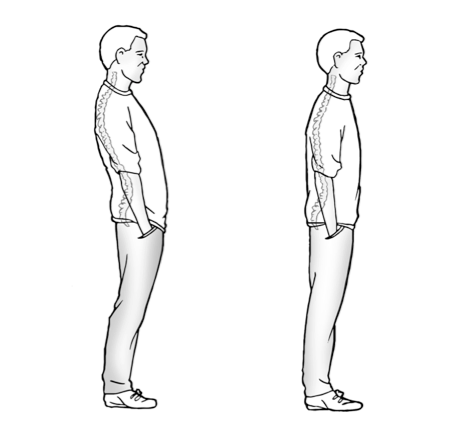
Standing male postureFM Alexander famously said that improved coordination comes ‘from the head downwards’. Does that mean that he neglected other parts of the body, including the feet? Definitely not. He knew from observing himself using a three-way mirror arrangement that while standing (and in motion) that as well as interfering with the balance of his head on his neck he was also making unnecessary muscular tension in his feet. In fact, he was contracting and bending his toes downwards in such a way that he was throwing his weight onto the outside of his feet, creating an arching effect, which in turn interfered with his overall balance.

Many of us will be able to identify with that or a similar type of misuse. For that reason we need to keep in mind that we do not possess the flat, extremely elastic and prehensile feet of ot
her primate species, such as apes and monkeys, which are so useful in tree climbing. In fact, one very important function of your parallel aligned toes is for balancing and feeling the ground. You can explore this by standing on one foot and then flexing your toes upwards so that none of them are in contact with the floor. It’s difficult to maintain balance, isn’t it? Your toes also play a vitally important role in locomotion. So you can also experiment with walking forward or backward with similarly upwardly-flexed toes on both feet. You will discover that this results in a tightening of your leg joints and torso and a pattern of movement which is very stiff and awkward.

The big problem is that most of us stand with too much weight on the front of the feet. However, this often goes with a pattern of general postural collapse – pulling the head down on to the neck, pulling the lower back in and stiffening the ankles, knees and hips. So if that’s what you’re doing in everyday life then you need to find a way of coming back from the pivot point of your ankle joints in such a way that the three contact points of the feet – areas around your heels, big toes and little toes – are equalised. But this is not just a matter of thinking of your feet in isolation; instead, it is a function of your general coordination. Put another way, balancing on your two feet is achieved not by ‘doing’ anything specific with your feet but by giving directions for your head, neck and back and then adding on suitable orders for your ankles, knees and hips joints and making a movement, such as walking forward, backward or sideways, so that as you move all your body’s joint surfaces are opening away from each other and your feet are releasing into the ground. As Alexander told those on his first teacher training course: ‘Everything in the body should be moving away from its nearest joint starting from the head.’

For more information read Seán Carey’s Alexander Technique in Everyday Activity: Improve how you sit, stand, walk, work and run

Available through Amazon with free P&P

Should you run in shoes or run barefoot? by Seán Carey

Running_shoes_display

Last week it was the effect on the feet of wearing high heels that was in the news. This week it’s whether running wearing a pair of trainers is better for you than running barefoot. University of Queensland researchers found that the cushioning and arch support features found in most modern trainers and running shoes can potentially impair ‘foot-spring function’– though with the important caveat that shod running may contribute to other advantages in a runner’s foot muscle function, especially in the activation of the muscles along the longitudinal arch of the foot. The researchers concluded (as researchers tend to do) that more research was required to explore the relationship between the foot and the muscles around the ankle and knee joints during running.

Certainly, all the top athletes I’ve observed in recent years wear some sort of shoe when competing. On the other hand, many elite middle and long-distance runners, hailing from rural areas in countries such as Kenya and Ethiopia, have grown up not wearing shoes or only wearing them occasionally. In fact, there is a huge advantage for all of us at least to walk barefoot whenever possible. Why? Well, the sensory nerves on the bottom of your feet provide important proprioceptive information about the ground you are walking on. Your brain and the rest of your nervous system interpret these signals to keep you upright with the minimum amount of effort in locomotion. This process is made more difficult if shoes are worn – and interestingly the more cushioned or stiffer the shoes, the worse the problem. In fact, even wearing socks on your feet interferes with this proprioceptive process.

However, walking barefoot and running barefoot are not equivalent activities. Most experts, such as Harvard evolutionary biologist Daniel Lieberman, recommend that if you are used to running with shoes but wish to make the change to running barefoot or using minimalist shoes you allow plenty of time to make the transition. And, from an Alexander Technique perspective, it’s not just your feet that you need to be concerned with. Much more important in many ways is the balance of your head on your neck. You want to keep your head freely poised so that your back musculature provides the necessary support for your body weight and allows your legs to move freely. Tighten your neck muscles and you’re pulling your head down on to your shoulders and compressing your whole body from the crown of your head to the soles of your feet. In short, you will run heavy and feel heavy. And that’s true whether your feet are shod or not.

For more information on walking and running read Seán Carey’s Alexander Technique in Everyday Activity: Improve how you sit, stand, walk, work and run

Available through Amazon with free P & P


How do you do the housework, in Goa?

Goa’s Patnem Beach

Can you lean forward from your hip joints, holding a brush, without compressing your double S-shaped spine, stiffening your legs and feet, or pulling your head down on to your neck? If you spend long hours sitting in a C-shaped slump in front of a screen, the answer is probably not. But look at this photo of two women sweeping Goa’s Patnem Beach just after sunrise. You will see that the woman in the blue sari is working much more efficiently than her colleague. By placing her open left hand on her lower back, the weight of that arm (around 4% of her body weight) can release through her pelvis, her legs and then into the ground. Her supported left arm also counterbalances the weight of her right arm which is holding the short broom made from coconut leaves. That, in turn, helps to keep her spine extended, supple and strong. Very clever. It also means that she will never experience chronic lower back pain!

By Seán Carey

For more information on how to bend and use yourself better read Seán Carey’s much-acclaimed book, ‘Alexander Technique in Everyday Activity: Improve how you sit, stand, walk, work and run’
Available through Amazon for £18.99


Can you stand on your toes?

Jessica Ennis-Hill

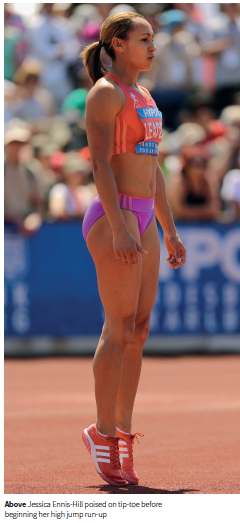
What do you do if you want to eat a juicy, but just-out-of reach, apple on a tree? You go up on to your toes, of course. In fact this movement on to the toes has likely played a very important part in the evolution of the uprightness and mobility of our species, including the unique ways humans walk, run and jump. Healthy, young children from all cultures are very good at going on to the toes – they just pop upwards – though interestingly many of us adults in Western-type societies perform the movement very badly. Why? Well, instead of maintaining alignment with your head balanced on top of your extended, double S-shaped spine, chances are that as you initiate the movement on to your toes your neck muscles will shorten and stiffen which, in turn, will result in your head compressing your spine and narrowing the back musculature. Simultaneously, you will sink into your legs and throw your body forward. Put simply, you have lost some of your internal length or, to use FM Alexander’s apt phrase, you have ‘shortened your stature’. Does it matter? It certainly does if you’re hungry and can’t stretch those extra centimetres to get that lovely apple! And shortening your stature not only involves stiffening from your head to your toes but also means that you are fixing your rib cage and barely breathing. Not good. But look at this picture of 2012 Olympic Heptathlon Champion Jessica Ennis-Hill standing on her toes in preparation for her run-up in the high jump. Jessica has brilliant alignment – head poised, spine extending, her back musculature widening, and her leg muscles stretching without strain. One last thing: although she is relatively small for a high jumper – she stands at 1.65 metres (5′ 5″) – Jessica has jumped 1.95 metres (6′ 5″) and was for many years joint British record holder for the outdoor event.

By Seán Carey

For more information on how going on to the toes should be performed read Seán Carey’s much-acclaimed book, ‘Alexander Technique in Everyday Activity: Improve how you sit, stand, walk, work and run’
Available through Amazon for £18.99

How do you stand?

Seán Carey explains how humans are the only animals that have the potential to stand fully upright – though how many of us actually do that?

Standing male posture

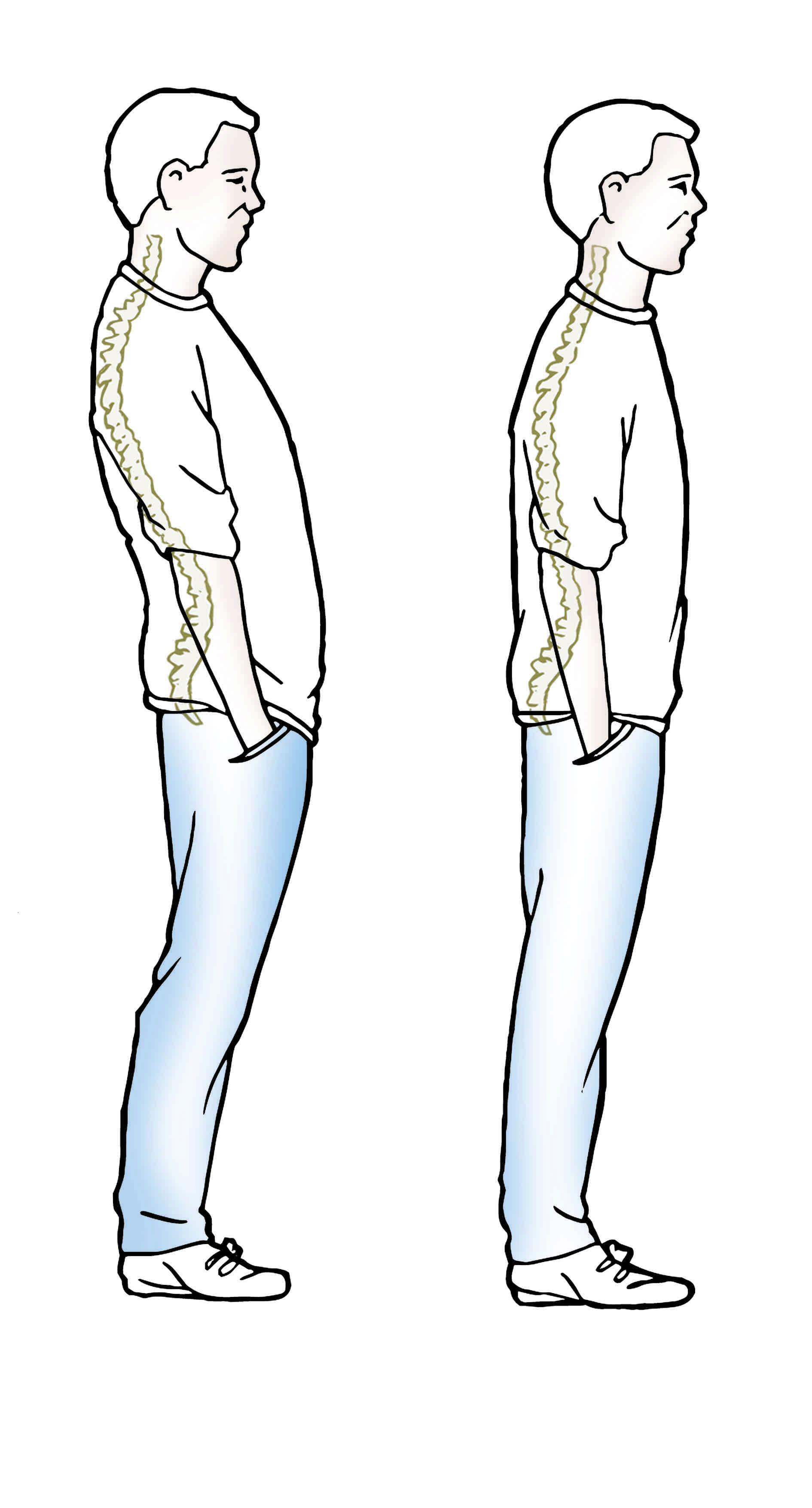
How much do you weigh? Eight, 10, 12 or 14 stone? Whatever your body weight you need good support from your musculoskeletal system to stand without strain. In fact, humans are the only species that can stand in a fully upright stance, with flexible ankles and fully extended knee and hip joints. With our joints stabilised by ligaments, body weight is then efficiently transmitted into the ground through the bones of a double S-shaped spine, pelvis, legs and the platforms of the feet, notably without much need to use the body’s large, powerful muscles, such as the gluteals, thighs and calves. Intriguingly, as anatomists have discovered, this alignment allows a healthy person to stand for hours, swaying slightly, using only seven per cent more energy than while lying on the ground.

But how many of us are capable of such efficiency in quiet standing? Very few, alas. The big problem for most of us is that we never, ever manage to come up to the potential of our full height – that is, the measurable distance between the crown of the head and the soles of the feet. Instead, we tend to droop or collapse, pulling the head down on to the neck, raising or collapsing the shoulders, pulling the lower back in and pushing the pelvis forward, as well as stiffening the muscles that operate the ankle, knee and hip joints. Given this pattern of mal-coordination, it’s hardly surprising that many of us suffer from a variety of musculoskeletal problems – chronic lower back pain, chronic neck pain, shoulder stiffness, achy legs or flat feet – as well as fatigue.

So is it possible to improve the efficiency of how you stand? Yes, although it’s fair to say that this takes more brainwork than physical work. For example, there’s no point trying to get some extra height by tightening the abdominal, gluteal or other muscles to ‘engage your core’ or by ‘tucking your tailbone under’. If you do either of these things you will only create additional tension – yet another ‘different form of badly’ to use philosopher and Alexander Technique enthusiast John Dewey’s pithy phrase – rather than a genuine release of your body’s musculature brought about by Alexander-style thinking (‘ordering’ or ‘directing’) that allows you to achieve your full height.

Seán Carey

For more information read Seán Carey’s Alexander Technique in Everyday Activity: Improve how you sit, stand, walk, work and run

Available through Amazon with free P&P