Should you run in shoes or run barefoot? by Seán Carey

Running_shoes_display

Last week it was the effect on the feet of wearing high heels that was in the news. This week it’s whether running wearing a pair of trainers is better for you than running barefoot. University of Queensland researchers found that the cushioning and arch support features found in most modern trainers and running shoes can potentially impair ‘foot-spring function’– though with the important caveat that shod running may contribute to other advantages in a runner’s foot muscle function, especially in the activation of the muscles along the longitudinal arch of the foot. The researchers concluded (as researchers tend to do) that more research was required to explore the relationship between the foot and the muscles around the ankle and knee joints during running.

Certainly, all the top athletes I’ve observed in recent years wear some sort of shoe when competing. On the other hand, many elite middle and long-distance runners, hailing from rural areas in countries such as Kenya and Ethiopia, have grown up not wearing shoes or only wearing them occasionally. In fact, there is a huge advantage for all of us at least to walk barefoot whenever possible. Why? Well, the sensory nerves on the bottom of your feet provide important proprioceptive information about the ground you are walking on. Your brain and the rest of your nervous system interpret these signals to keep you upright with the minimum amount of effort in locomotion. This process is made more difficult if shoes are worn – and interestingly the more cushioned or stiffer the shoes, the worse the problem. In fact, even wearing socks on your feet interferes with this proprioceptive process.

However, walking barefoot and running barefoot are not equivalent activities. Most experts, such as Harvard evolutionary biologist Daniel Lieberman, recommend that if you are used to running with shoes but wish to make the change to running barefoot or using minimalist shoes you allow plenty of time to make the transition. And, from an Alexander Technique perspective, it’s not just your feet that you need to be concerned with. Much more important in many ways is the balance of your head on your neck. You want to keep your head freely poised so that your back musculature provides the necessary support for your body weight and allows your legs to move freely. Tighten your neck muscles and you’re pulling your head down on to your shoulders and compressing your whole body from the crown of your head to the soles of your feet. In short, you will run heavy and feel heavy. And that’s true whether your feet are shod or not.

For more information on walking and running read Seán Carey’s Alexander Technique in Everyday Activity: Improve how you sit, stand, walk, work and run

Available through Amazon with free P & P
 

Should you wear high heels? by Seán Carey

Shoes Modelled ATiEA

High heels are in the news again. Women, who have been told to wear high heels at work are being invited to tell their stories to a group of MPs in order to gain legal clarity about whether UK employers can force female employees to wear such footwear. The initiative by parliamentarians came after a petition calling for a ban on women being obliged to wear high heels in the workplace gathered more than 142,000 signatures (mine was one of them).

In fact, the use of footwear is a relatively recent development in human history. The world’s oldest preserved shoes were constructed from sagebrush bark fibre by Native Americans keen to insulate themselves against freezing temperatures in the Pacific Northwest around 10,500 years ago. Many contemporary populations living in warm climates in the developing world never wear shoes. Such barefoot people tend to have wide feet, pronounced arches and evenly distributed plantar pressure. By contrast, habitual shoe wearers have narrower feet, exhibit very high focal pressures at the heel, big toe and ball of the foot, and often suffer anatomical abnormalities, such as weak toes, bunions and flat feet.

High heels are particularly significant in this regard. Evidence suggests that extensive use of such footwear, especially ultra-high heels, is linked with significant physical problems. It’s associated with marked shortening of the highly malleable muscle fibres that make up the calves as well as thicker and stiffer Achilles tendons. Long-term use of high heels is also correlated with the development of on-going foot pain and restriction in the range of movement of the ankles. Unsurprisingly those problems show up more in ageing adults.

When people ask me in my role as an Alexander Technique teacher what shoes they should wear, I ask them what footwear would they select if they had to walk or run quickly? High heels, platform shoes, and flip-flops would not be a good choice, even for the very well-coordinated. They all interfere with your balance and alignment and decrease your potential speed in walking or running. The optimum choice is well-fitting shoes, with thin, flexible soles that follow the movement of your feet without the need to try to hang on with your toes.

So it’s probably best to wear a pair of Christian Louboutin-type heels only on very special occasions. If you do put them on try to walk on the balls of your feet rather than landing on the heels – though be aware that you are using around 50 per cent more energy compared with a normal heel-sole-toe movement as you would do if you were walking barefoot or in thin-sole shoes.

For more information on your feet and other parts of your body-mind continuum read Seán Carey’s Alexander Technique in Everyday Activity: Improve how you sit, stand, walk, work and run

Available through Amazon with free P & P


Why F M Alexander name checked the latissimus dorsi muscles – Seán Carey

FM Alexander, the founder of the Alexander Technique, rarely mentioned specific skeletal muscles in his writings but he made an exception in his account of the hands over the back of a chair procedure detailed in his second book, Constructive Conscious Control of the Individual, where he name checked the latissimus dorsi muscles.

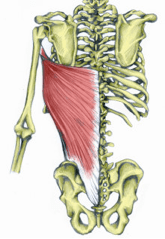
Latissimus dorsiThe flat, fan-like latissimus dorsi muscles are part of a group of what anatomists term “superficial muscles” – that is, they are to be found just under your skin. In fact, you can easily locate part of one or other latissimus dorsi muscle by using your fingers and thumb to pinch the widest part of your back behind your armpit.

But why would Alexander specifically mention these muscles? Well, firstly because he was always interested in anything involved with breathing. Although the latissimus dorsi muscles are not primary breathing muscles, they do assist with the contraction and expansion of your rib cage. The second reason he was interested is because the latissimus dorsi muscles are the only ones in the body that connect the pelvis to the arms as each muscle runs from the lower back, travelling up around the outside of the rib cage to pass through the armpit and then attaches to the inner side of the upper arm bone, just below the shoulder joint. Although thin the latissimus dorsi muscles are incredibly powerful. Furthermore, even though Alexander did not explicitly spell it out these muscles play a hugely important role in any number of everyday movements in which you use your hands to manipulate objects. For example, you employ the latissimus dorsi muscles to open a fridge door, remove clothes from a washing machine, pull weeds out of the ground, or with your hand on a banister pull yourself up the stairs. If you are an athlete you will also be interested to know that also you use them in running, throwing and swimming.

As anyone familiar with the Alexander Technique knows, it’s best to use our muscles at their optimum length. But the intriguing characteristic of the latissimus dorsi muscles is that unlike other muscles, such as erector spinae, that run from your tailbone to your head and help to maintain or create lengthening in your body, your stretched or released latissimus dorsi muscles act to both lengthen and widen your torso. Which is good news because that helps your legs to release away from your trunk so that you experience what Alexander called “lengthening of the stature” – the ongoing stretch or release between the crown of your head and the soles of your feet. That’s beneficial because you will then breathe more easily and more deeply without any need to focus directly on breathing (as in popular activities such as yoga, Pilates or mindfulness). Furthermore, tight latissimus dorsi muscles can cause chronic neck, shoulder, middle or lower back pain, and rounded shoulders.

So, Alexander was right to draw our attention to the latissimus dorsi muscles not in an abstract or “academic” sense but because it’s to our advantage to develop awareness of them at a sensory level through an activity such as hands over the back of a chair to restore or maintain good general muscular elasticity and coordination.

For more information on the body-mind continuum and the hands over the back of the chair procedure read Seán Carey’s Alexander Technique in Everyday Activity: Improve how you sit, stand, walk, work and run.

Available through Amazon for £18.99 with free P&P.

Private one-to-one Alexander Technique sessions can be booked with Seán Carey on Thursdays afternoons with HITE Ltd, 10 Harley Street, London W1G 9PF. Tel: 020 7467 8461

Is your mind like a foraging squirrel in a park? Seán Carey

“The mind races around like a foraging squirrel in a park, grabbing in turn at a flashing phone-screen, a distant mark on the wall, a clink of cups, a cloud that resembles a whale, a memory of something a friend said yesterday, a twinge in the knee, a pressing deadline, a vague expectation of nice weather later, a tick of the clock,” says Sarah Bakewell in her excellent new book on phenomenology and existentialism, At The Existentialist Cafe: Freedom, Being, and Apricot Cocktails.

Squirrel

In the analogy of the mind as a foraging squirrel there’s no doubt that Bakewell provides a pretty good description of how many of us experience the world while we are awake. However, whether everyone in all cultures, or indeed at all times, experiences life in such a frantic fashion is an interesting question. I would argue not. Why? Well, partly on the grounds that Bakewell’s list of attention-demanding objects or experiences is so thoroughly Western, urban and post-modern (think of people working in cities such as London, New York, Paris or Tokyo who make their livelihoods through listening, talking and typing and take frequent coffee breaks but probably not East African hunter-gatherers digging for tubers, collecting baobab fruits or chasing baboons), and partly on the grounds that those of us who have had lessons from a competent Alexander Technique teacher know very well that when the head achieves a better balance on top of the spinal column, allowing the neck and back muscles to provide support and stability for the whole body, this results in a less strained, more rhythmic pattern of breathing as well as clearer vision. At this point our experience of ourselves in time and space is no longer dominated by a habitually restless squirrel-like mind with a subordinate, barely-felt body but is transformed into an experience and also an appreciation of how one’s body and mind are so profoundly interconnected.

For more information on using the arms and hands read Seán Carey’s ‘Alexander Technique in Everyday Activity: Improve how you sit, stand, walk, work and run’

Available through Amazon for £18.99 with free P&P.

Private one-to-one Alexander Technique sessions can be booked with Seán Carey on Thursdays afternoons with HITE Ltd, 10 Harley Street, London W1G 9PF. Tel: 020 7467 8461

How do you use your hands?

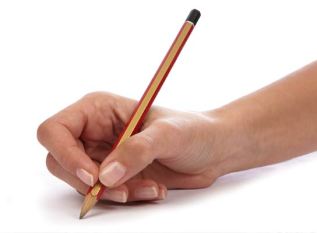
pencil_grip3

What’s the difference between you and your nearest living relatives, chimpanzees and bonobos? Well, not too much in terms of DNA percentages but quite a lot in terms of how the hands work. One key difference is that while chimps and bonobos have long fingers but short, weak, immobile thumbs, you have relatively short fingers but long, strong, mobile thumbs. The result is that, unlike your great ape relatives, you can you fully oppose your thumbs and the pads of each of your fingers, a pattern that enables you to grip or pinch objects with great precision. You employ it all the time in everyday life – for example, when buttoning your shirt, text messaging, or holding a pencil or picking up a coin.

Interestingly, healthy, young children are very dextrous – typically, toddlers can easily hold a round object such as a ball much bigger than their hand by elastically opening the hand very wide, thumb angled away from their other fingers, and then making contact with the top or side of the ball with a minimum amount of flexion or grip. It’s as if the child’s hand is sticking to the ball. How many adults are capable of this? Not many because most of us create too much muscle tension not only in the hands and arms but also in the rest of the body’s musculature, especially in the upper torso. Which is a great shame. But you can learn how to undo excess muscular tension by paying attention to how you use your hands in conjunction with what FM Alexander, the founder of the Alexander Technique, called the ‘primary control’ – maintaining the balance of your head, while your supportive back muscles lengthen and widen to provide stability not only for your head but also for your arms and hands.

By Seán Carey PhD

For more information on using the arms and hands read Seán Carey’s ‘Alexander Technique in Everyday Activity: Improve how you sit, stand, walk, work and run’

Available through Amazon for £18.99

Private one-to-one Alexander Technique sessions can be booked with Seán Carey on Thursdays afternoons with HITE Ltd, 10 Harley Street, London W1G 9PF. Tel: 020 7467 8461

How do you do the housework, in Goa?

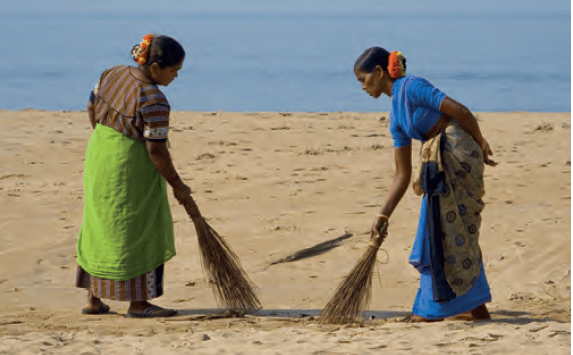
Goa’s Patnem Beach

Can you lean forward from your hip joints, holding a brush, without compressing your double S-shaped spine, stiffening your legs and feet, or pulling your head down on to your neck? If you spend long hours sitting in a C-shaped slump in front of a screen, the answer is probably not. But look at this photo of two women sweeping Goa’s Patnem Beach just after sunrise. You will see that the woman in the blue sari is working much more efficiently than her colleague. By placing her open left hand on her lower back, the weight of that arm (around 4% of her body weight) can release through her pelvis, her legs and then into the ground. Her supported left arm also counterbalances the weight of her right arm which is holding the short broom made from coconut leaves. That, in turn, helps to keep her spine extended, supple and strong. Very clever. It also means that she will never experience chronic lower back pain!

By Seán Carey

For more information on how to bend and use yourself better read Seán Carey’s much-acclaimed book, ‘Alexander Technique in Everyday Activity: Improve how you sit, stand, walk, work and run’
Available through Amazon for £18.99


Can you stand on your toes?

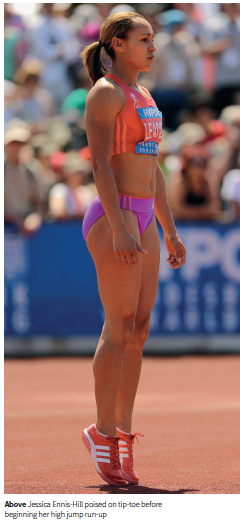
Jessica Ennis-Hill

What do you do if you want to eat a juicy, but just-out-of reach, apple on a tree? You go up on to your toes, of course. In fact this movement on to the toes has likely played a very important part in the evolution of the uprightness and mobility of our species, including the unique ways humans walk, run and jump. Healthy, young children from all cultures are very good at going on to the toes – they just pop upwards – though interestingly many of us adults in Western-type societies perform the movement very badly. Why? Well, instead of maintaining alignment with your head balanced on top of your extended, double S-shaped spine, chances are that as you initiate the movement on to your toes your neck muscles will shorten and stiffen which, in turn, will result in your head compressing your spine and narrowing the back musculature. Simultaneously, you will sink into your legs and throw your body forward. Put simply, you have lost some of your internal length or, to use FM Alexander’s apt phrase, you have ‘shortened your stature’. Does it matter? It certainly does if you’re hungry and can’t stretch those extra centimetres to get that lovely apple! And shortening your stature not only involves stiffening from your head to your toes but also means that you are fixing your rib cage and barely breathing. Not good. But look at this picture of 2012 Olympic Heptathlon Champion Jessica Ennis-Hill standing on her toes in preparation for her run-up in the high jump. Jessica has brilliant alignment – head poised, spine extending, her back musculature widening, and her leg muscles stretching without strain. One last thing: although she is relatively small for a high jumper – she stands at 1.65 metres (5′ 5″) – Jessica has jumped 1.95 metres (6′ 5″) and was for many years joint British record holder for the outdoor event.

By Seán Carey

For more information on how going on to the toes should be performed read Seán Carey’s much-acclaimed book, ‘Alexander Technique in Everyday Activity: Improve how you sit, stand, walk, work and run’
Available through Amazon for £18.99

How do you stand?

Seán Carey explains how humans are the only animals that have the potential to stand fully upright – though how many of us actually do that?

Standing male posture

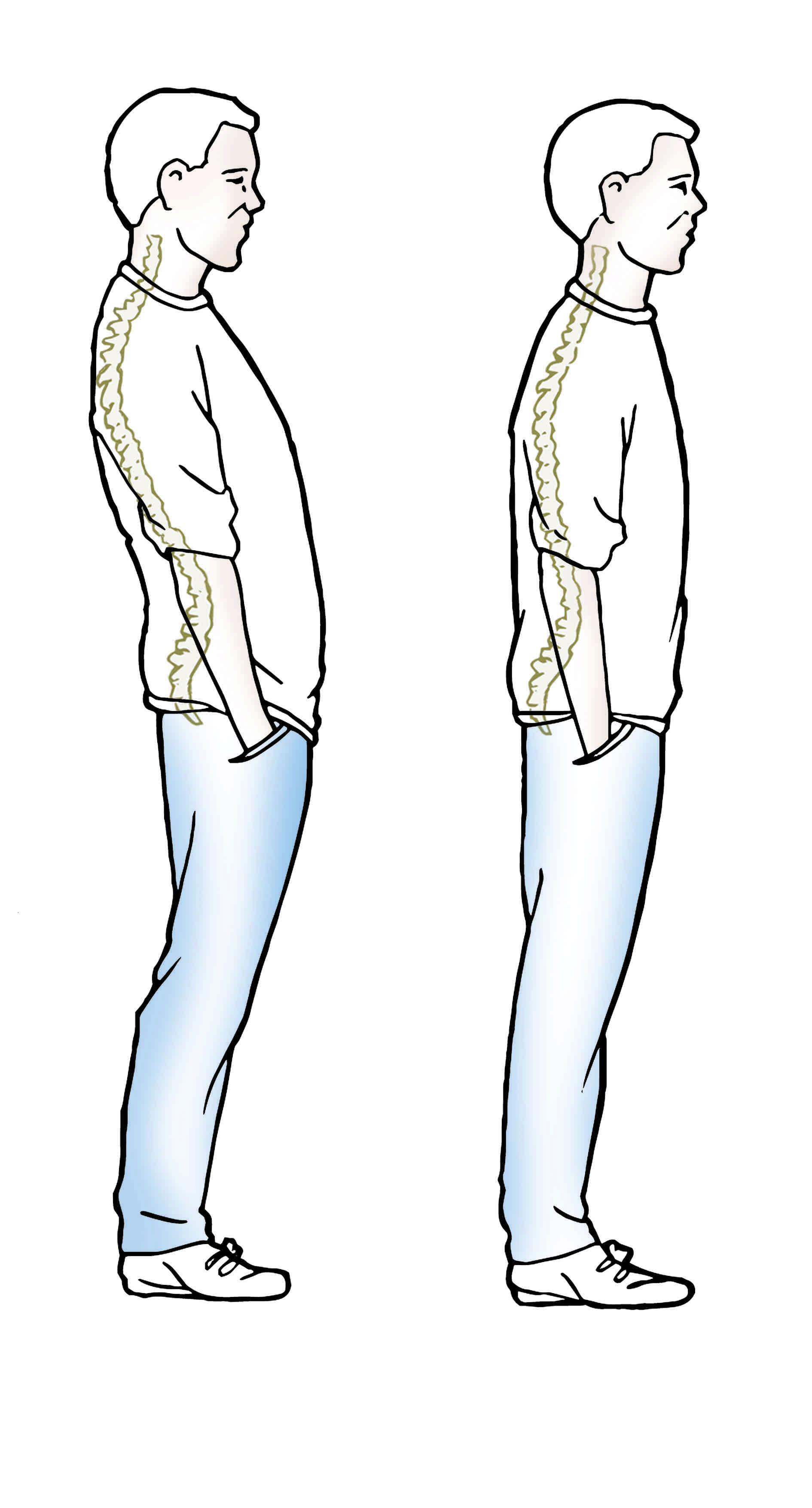
How much do you weigh? Eight, 10, 12 or 14 stone? Whatever your body weight you need good support from your musculoskeletal system to stand without strain. In fact, humans are the only species that can stand in a fully upright stance, with flexible ankles and fully extended knee and hip joints. With our joints stabilised by ligaments, body weight is then efficiently transmitted into the ground through the bones of a double S-shaped spine, pelvis, legs and the platforms of the feet, notably without much need to use the body’s large, powerful muscles, such as the gluteals, thighs and calves. Intriguingly, as anatomists have discovered, this alignment allows a healthy person to stand for hours, swaying slightly, using only seven per cent more energy than while lying on the ground.

But how many of us are capable of such efficiency in quiet standing? Very few, alas. The big problem for most of us is that we never, ever manage to come up to the potential of our full height – that is, the measurable distance between the crown of the head and the soles of the feet. Instead, we tend to droop or collapse, pulling the head down on to the neck, raising or collapsing the shoulders, pulling the lower back in and pushing the pelvis forward, as well as stiffening the muscles that operate the ankle, knee and hip joints. Given this pattern of mal-coordination, it’s hardly surprising that many of us suffer from a variety of musculoskeletal problems – chronic lower back pain, chronic neck pain, shoulder stiffness, achy legs or flat feet – as well as fatigue.

So is it possible to improve the efficiency of how you stand? Yes, although it’s fair to say that this takes more brainwork than physical work. For example, there’s no point trying to get some extra height by tightening the abdominal, gluteal or other muscles to ‘engage your core’ or by ‘tucking your tailbone under’. If you do either of these things you will only create additional tension – yet another ‘different form of badly’ to use philosopher and Alexander Technique enthusiast John Dewey’s pithy phrase – rather than a genuine release of your body’s musculature brought about by Alexander-style thinking (‘ordering’ or ‘directing’) that allows you to achieve your full height.

Seán Carey

For more information read Seán Carey’s Alexander Technique in Everyday Activity: Improve how you sit, stand, walk, work and run

Available through Amazon with free P&P

Pointing is key

Pointing is key to learning the Alexander Technique – Seán Carey PhD

‘See, even at the age of 98, I can still move my arms above my head,’ said Elisabeth Walker at the end of my one and only lesson with her at her Oxford home. She was responding to my question concerning whether FM Alexander, the founder of the Alexander Technique, had offered her and other students on his teacher training course much advice about extending or pointing the arms out to the sides, or above the head. ‘But he didn’t really make a big thing about it,’ she added. ‘Nevertheless, it’s very good for musicians and other people who get very tight in the armpits and need to get release.’

That conversation got me thinking more about gesture and pointing in particular. Humans are a very social species and a crucial building block in the development of that sociality is movement of the arms and hands, with or without accompanying speech. One gesture that seems to be especially important in our social development is pointing with an extended index finger. In fact, you would have started using that gesture around your first birthday, before you could talk, to get and direct the attention of adults and other children nearby to an object you wanted, such as food, a drink or a toy, or something that you found interesting, such as a hovering bumblebee, a slow-moving cat or a fast-moving aeroplane. In doing so, you discovered that movement can initiate and then maintain shared body-mind experiences. Simply put, people pay attention when you point, and you pay attention when they point.

It’s also evident that what comparative or developmental psychologists call purposeful or declarative-pointing with the index finger (which triggers extension or lengthening of the arm as illustrated in the photo below) is something for which we are peculiarly well adapted. It’s a behaviour found in all cultures. Some psychologists go further and claim that directed index finger-pointing is a uniquely human gesture as there is no reliable account of any of our great ape cousins living in the wild using it to communicate with other apes.


shutterstock_41063452

Above We are peculiarly well-adapted to pointing with our index finger

The unique human ability to point not only your index finger but also your other fingers is certainly used to good effect in the Alexander Technique as it forms an important part of some specialised procedures, one of which Elisabeth Walker demonstrated for me in March 2013.

Another example is placing hands over the back of a chair. Alexander himself would ask a student to sit upright on a chair facing the back of a second chair equipped with a reasonably high back. Maintaining the balance of the head on the neck he slowly brought the student’s body forwards from the hip joints, carefully monitoring whether at any stage they compressed their double-S shaped spine. (If that happened Alexander would go back to the beginning of the sequence.) With the student leaning forward at an angle Alexander instructed them to take their time and then extend or point their fingers before taking hold of the top rail of the chair in front, using a gentle but firm beak-like grip with each hand, with the wrists pointing inwards towards each other and the elbows pointing outwards and slightly downwards. This opposition of fingers, wrists and elbows pointing in different directions creates a gentle forearm pull or stretch from the fingers-opposing-thumbs contact. This can be further amplified by directing the shoulders to release or point away from each other.

If you are not familiar with the procedure it might appear to be rather strange. In fact leaning forwards and then placing the hands on the back of a chair in this way generates a dynamic, elastic muscular release not only in the arms but also in the neck and shoulder girdle, and rib cage and pelvis. It also helps to fine tune your kinaesthetic sense. I have written about hands over the back of a chair in sitting and standing in some detail in my new book, Alexander Technique in Everyday Activity.

And I remember talking to Alexander’s niece, first-generation teacher Marjory Barlow, who I interviewed for Alexander Technique: the Ground Rules, about the problem many new students of the technique experience in letting their knees release forwards from the hip joints and away from each other as they move from standing on two feet to sitting in a more balanced way on their downward-pointing sitting bones. Marjory told me that whenever she encountered any difficulty she would not only ask the student to inhibit their immediate reaction to the stimulus to sit (typically by trying to actively place their bottom on the chair, pulling their knees together and pulling their head down on to their neck) but also ask them to think about and then consciously point their knees forward and away in the direction of suitable objects in her teaching room, such as a radiator or lamp, as with her hands she provided the experience of maintaining the integrity of the head, neck and back relationship. It was good advice.

A final thought. When you were younger you may have been told off by your parents for pointing at other people – “Don’t point, it’s rude!” is the customary form of words – but I hope I have said enough to convince your adult self that inhibiting and then pointing your fingers, elbows and knees and mentally other body parts, such as the shoulders, using the minimum amount of effort, is a good thing. In fact, it’s key to learning the Alexander Technique.

one thing into another


by Lucy Ash, artist – Alexander Technique pupil of Kamal Thapen

When I started to learn the Alexander Technique, I kept being reminded of this quote by Pablo Picasso. ‘It took me four years to paint like Raphael, but a lifetime to paint like a child.’ The point about the Alexander Technique is that it’s about unlearning everything we have learned – what feels familiar and comfortable is often bad for us – routines of behavior acquired subconsciously over the years by repeating the same action again and again are likely to be the wrong actions. By adopting a technique that is about thinking and then doing, we can create positive change. But like Picasso this unlearning, the business of doing of things differently, takes time and courage.

Applying a technique to our approach to life and the world around us can have very powerful results, but you have to take a leap of faith. As a painter it helps me to apply a technique to my work that is about self-awareness and understanding my body, that way I can get more from it. Painting is very physical, so my body has to work for me. How well I paint depends on my awareness, my thought process, my sensitivity and intuition. By becoming more sensitive I can make better decisions and be more agile. Making art, like the Alexander Technique, is a lot about how the conscious mind connects and directs the unconscious mind so the work has a resonance. I work with mixed media, usually oil paints, spray paint and ink. The process of using mixed media is very exciting – there’s the wonderful thing of how the oil paint and spray paint interact, it’s not entirely predictable and is a process of discovery where I may not know what I’m doing but find out by doing it and being brave. Molding something out of nothing with a mixture of mediums is a big part of what my work is about. Like the Alexander Technique it’s not about the end game it’s about the process. Not knowing where colliding particles will land, not controlling them and not worrying about the rules is part of my approach to creativity.

 Image 

‘one thing into another’ mixed media on linen, 168 cm x 213 cm, 5’ 6” X 7’

Bringing something experimental all together to create a sense of wholeness gives a feeling of completion and satisfaction and pleasure. The pieces of a painting make sense of the whole; in the same way that the pieces of our body make up a whole. The relationship between our neck and head affect to the rest of our body and every subsequent movement and action stem from this connection which, when it works, brings about a graceful and fluid movement. If part of your body is out of sync it affects your whole being, which not only has ramifications on how well we feel but also on how we relate to the world and how the world relates to us, plus it parallels the quality of work we produce as well as the process of painting.

Painters are a bit like magicians in how they transform one thing into another and something out of nothing as well as juggle the constantly changing relationships that have ramifications throughout the whole rest of the work. One mark leads to another; a small mark can instigate big change, which is the exciting part of creating.  So why is change, which is so inevitable, so very unwelcome? A changing world and personal change are incredibly scary even when the status quo isn’t that great. What we know is what we like because it feels familiar and safe and is where we would like to stay if we could, but we can’t. A technique such as Alexander equips us with the tools we need to venture out from the known present into the unknown future. It’s about the fundamental nature of being, integrating and grounding the whole person; it allows bad habits to be unlearned, great works of art to be painted, and needs to be embraced.

 Image

‘one thing into another’, Winchester Cathedral, 2013, part of Creative Collisions 10 days Winchester